



Direct answer
A UK business can use a development team outside the UK. If a separate overseas agency or contractor can access personal data, even remotely on a UK-hosted server, that access can be a restricted transfer. The workable answer is layered: name the controller, processor and sub-processors; sign Article 28 terms; use adequacy or a safeguard such as the IDTA or Addendum where needed; complete the transfer risk assessment; and build synthetic data, least privilege, expiring access and audit logs into the engineering itself.
Key takeaways
- “Our database is in London” and “we signed an NDA” are not compliance answers.
- Remote access by a separate legal entity can be a restricted transfer. An employee of the same entity working abroad is not.
- Article 28 terms and a transfer mechanism do different jobs. Most arrangements need both.
- UK clients ask for a DPA, dummy data and database-level roles. Nobody asks for an IDTA by name.
- Score the exposure of every production-access request before granting it.
Separate the role, the route and the access
UK GDPR treats these as three different questions. Most overseas arrangements answer one of them well and assume the other two follow.
The UK business is usually the controller. An agency working on documented instructions is a processor. Hosting, error-tracking and support tools are sub-processors. The real decisions settle the role, not the label in the proposal.
The ICO’s definition of a transfer includes making data accessible, so remote production access counts even when the data never leaves a UK region. It is restricted when UK GDPR applies, the receiver is outside the UK, and the receiver is a separate legal entity.
A signed document cannot make broad production access safe. The ICO’s security outcomes ask for access limited to people who need it, strong authentication, controls on downloads, audit trails and monitoring. Pseudonymised data is still personal data for the controller and its processor.
The compliance stack for an overseas team
For a restricted transfer the route is UK adequacy regulations, an appropriate safeguard, or a limited exception. Article 46 safeguards include the ICO’s International Data Transfer Agreement (IDTA) and the UK Addendum to the EU Standard Contractual Clauses. Either way a transfer risk assessment, now the “data protection test” in the legislation, has to be completed and its extra protections implemented. The ICO says the current IDTA and Addendum remain in use while the 2026 refresh following the Data (Use and Access) Act 2025 is prepared. ICO: rules on appropriate safeguards · ICO: the IDTA and Addendum
What UK clients actually ask an overseas team for
For this guide we went back through our own UK engagement records from 2022 to 2026: briefs, tenders, proposals and delivery channels. Client names are withheld. The pattern is more practical than the legal literature suggests.
A data processing agreement before the build. Development on dummy data only. Real records withheld until developer access is restricted after handover. Roles enforced at database level, proven by a direct query with the support credentials returning no financial data. Super-admin removed at sign-off, then a six-monthly access review.
A per-tenant audit-log table in the schema from the first migration. Secrets in a managed vault, not environment files. Admin, manager and viewer roles in the foundation. Per-individual export and deletion in phase one. The platform operator is the processor for its subscribing companies; we supply the technical inputs, not the legal document.
A DPA naming Appycodes as processor, signed before any member data moves. UK hosting. Consent and unsubscribe status migrated and enforced from day one. Read-only access to the payment provider for verification. Exports written to the audit trail. Two SaaS vendors excluded for US-only hosting.
The client’s data-protection lead refused a CRM plugin that would push the whole client database to a third-party service. We built a scoped property-listings feed delivered twice daily over SFTP instead, with no CRM access at all.
- Nobody asked for an IDTA or the Addendum by name. They asked for a DPA, dummy data, database-level roles and access reviews. The transfer mechanism is still the controller’s obligation under Chapter V, so a supplier that raises it unprompted lowers everyone’s risk.
- “Database level, not UI level” is the test that matters. A client who asks you to run a direct query with the support credentials and show it returns nothing sensitive has understood the problem better than most vendor questionnaires.
- Access removal has to be scheduled, not remembered. Super-admin off at sign-off, a narrower support role afterwards, a review every six months.
A real boundary: a UK energy broker’s ERP, built from India
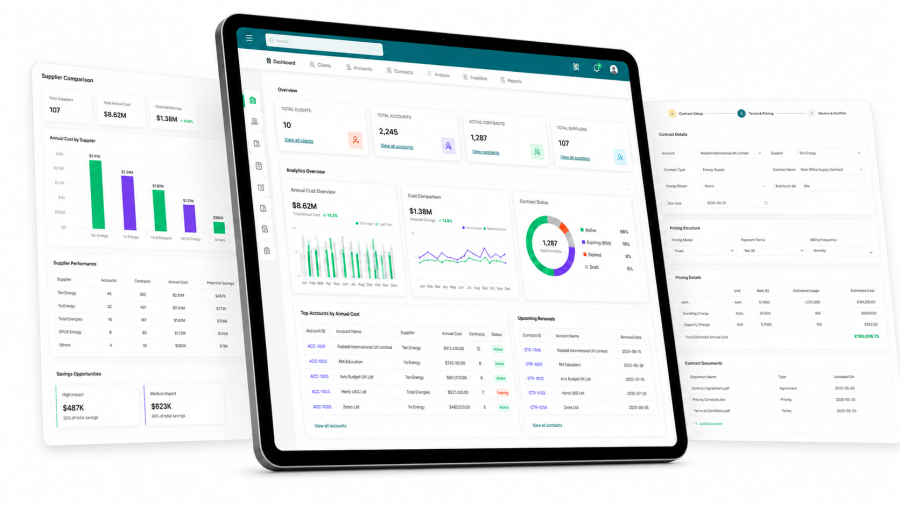
Since 2023 our India-based team has built and run the ERP for a leading UK energy broker: clients, contacts, addresses, meter points, supplier tenders, contracts, brokerage accounting, half-hourly consumption, invoice validation and an S3 document vault, in one Laravel system with role-based access for administrators, operations staff and partner brokers.
The hard decision was consolidation versus exposure. Moving the operation out of spreadsheets and inboxes created a coherent system of record and concentrated data that used to sit apart. The answer was role-aware access: a partner broker sees their slice, not the administrator’s. The same rule extends to development and support. A person debugging an importer does not need the full contact, contract and document view.
Score the exposure before granting access
The Production Access Exposure Score is our triage model for a proposed development or support workflow. It does not decide whether a transfer is lawful. It tells the product owner how urgently to shrink the technical exposure before anyone gets access.
A named engineer viewing a status and an error code for two hours scores two or less. The same engineer with standing database-admin access, exports and customer documents scores seven or more. Same business problem, different exposure.
A data-light delivery path and an exceptional production path
This makes the lower-risk path the fastest path. Developers reproduce validation, import and rendering faults with representative fixtures. When a production-only problem genuinely needs a record, the team requests a short-lived grant against a named client, purpose and field list. The gateway owns the query and the audit event. The engineer never receives a reusable database credential.
type SupportSession = {
  engineerId: string;
  clientId: string;
  purpose: "incident" | "data-correction" | "release-check";
  approvedBy: string;
  expiresAt: Date;
  fields: Array<"accountRef" | "status" | "postcodeArea" | "errorCode">;
};

const SAFE_FIELDS = new Set(["accountRef", "status", "postcodeArea", "errorCode"]);

export async function readSupportRecord(session: SupportSession, recordId: string) {
  if (session.expiresAt <= new Date()) throw new Error("Grant expired");
  if (!session.approvedBy) throw new Error("Approval required");
  if (session.fields.some((f) => !SAFE_FIELDS.has(f))) {
    throw new Error("Field is outside the support allow-list");
  }

  // The query is built from a fixed server-side allow-list, never user input.
  const select = Object.fromEntries(session.fields.map((f) => [f, true]));
  const record = await db.customerAccount.findFirst({
    where: { id: recordId, clientId: session.clientId },
    select,
  });

  await db.productionAccessEvent.create({
    data: {
      engineerId: session.engineerId,
      clientId: session.clientId,
      recordId,
      purpose: session.purpose,
      approvedBy: session.approvedBy,
      fields: session.fields,
      grantExpiresAt: session.expiresAt,
      occurredAt: new Date(),
    },
  });

  return record;
}
In production, connect the gateway to the identity provider, require phishing-resistant MFA for privileged roles, send approvals to a different person, prevent arbitrary query construction and alert on bulk reads. Keep the log itself minimal: who, why, which record, when. Not another copy of the data.
Failure modes that appear after the paperwork is signed
Every developer and staging integration inherits the live exposure. Generate fixtures; anonymise irreversibly only where a real distribution is needed.
Personal data travels into logs, chat and observability sub-processors. Log stable identifiers and error classes; redact bodies by default.
No attribution, weak offboarding, excessive privilege. Named accounts, SSO with MFA, role grants and automatic expiry.
Old staff or suppliers keep a path into live data. One exit checklist across Git, cloud, database, support tools, VPN and vendor consoles.
A DPIA is required where processing is likely to be high risk, and the same discipline is useful for any new production-access path: describe the processing, assess necessity, identify harm, mitigate before launch. ICO: what is a DPIA?
Recommendations by business type
A purpose-built customer view with tenant scoping, masked fields, impersonation notices and expiry. The database console is not the support interface.
Provider IDs, order states and redacted addresses for debugging. Never copy card data. Refunds and address changes are separate privileged actions.
A developer fixing an invoice parser needs the document type and extracted fields, not the CRM relationship. Separate document, accounting, contact and contract permissions.
Score safeguarding, beneficiary and children’s data at the top of the model. Prefer UK-side diagnostics and synthetic records; use a DPIA and specialist review.
Frequently asked questions
- Can a UK company legally use developers outside the UK?
- Yes. UK GDPR does not prohibit overseas development. The UK organisation must identify the parties and data flows, put controller-processor terms in place, use a valid transfer mechanism where the arrangement is a restricted transfer, and apply security proportionate to the data and risk.
- Is remote access from abroad an international data transfer?
- It can be. ICO guidance says making personal information accessible to a separate organisation outside the UK can be a transfer, including remote access to systems. Whether it is restricted depends on the ICO's three-step test, including whether the receiver is a separate legal entity.
- Does keeping production servers in the UK avoid transfer rules?
- Not by itself. Server location and access location are different questions. A separate overseas organisation remotely accessing personal information held on UK servers can still create a restricted transfer.
- Do we need both a data processing agreement and an IDTA?
- Often, yes. Article 28 processor terms govern processing on the controller's instructions. An IDTA, or the UK Addendum with EU SCCs, provides an appropriate safeguard for a restricted transfer when adequacy does not cover it. A transfer risk assessment is also required when relying on appropriate safeguards.
- What do UK clients actually ask an overseas developer for?
- In the Appycodes engagement records reviewed for this guide: a signed data processing agreement, development on dummy data only, role restrictions enforced at database level, removal of super-admin access at sign-off and periodic access reviews. None asked for an IDTA or the Addendum by name.
Primary sources
- ICO guide to international transfers
- ICO restricted-transfer three-step test
- ICO controller-processor contract requirements
- ICO appropriate-safeguards rules
- ICO IDTA and Addendum guidance
- ICO data-security outcomes
- ICO DPIA guidance
Technical and operational guidance, not legal advice. Have the final arrangement reviewed by a qualified UK data-protection professional.
UK topic cluster
Engineering & compliance
UK hosting, GDPR, performance, accessibility and delivery guidance.
Related guide
Companies House API for onboarding
Data minimisation and evidence around UK company records.
Case study
UK energy-broker ERP
The client, contract, invoice and document workflows behind this access model.